Compliance at the Speed of AI: One Retail Hub
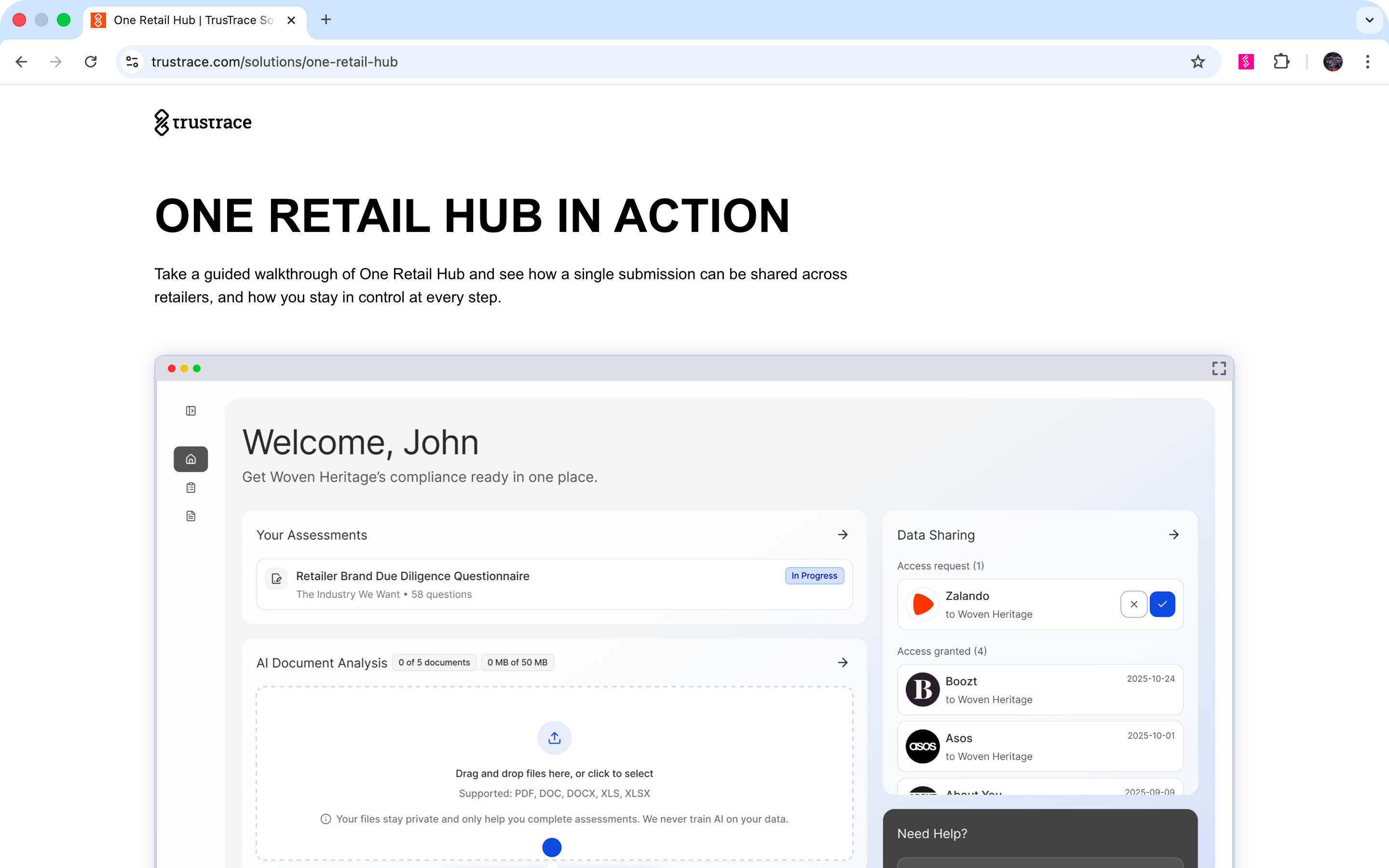
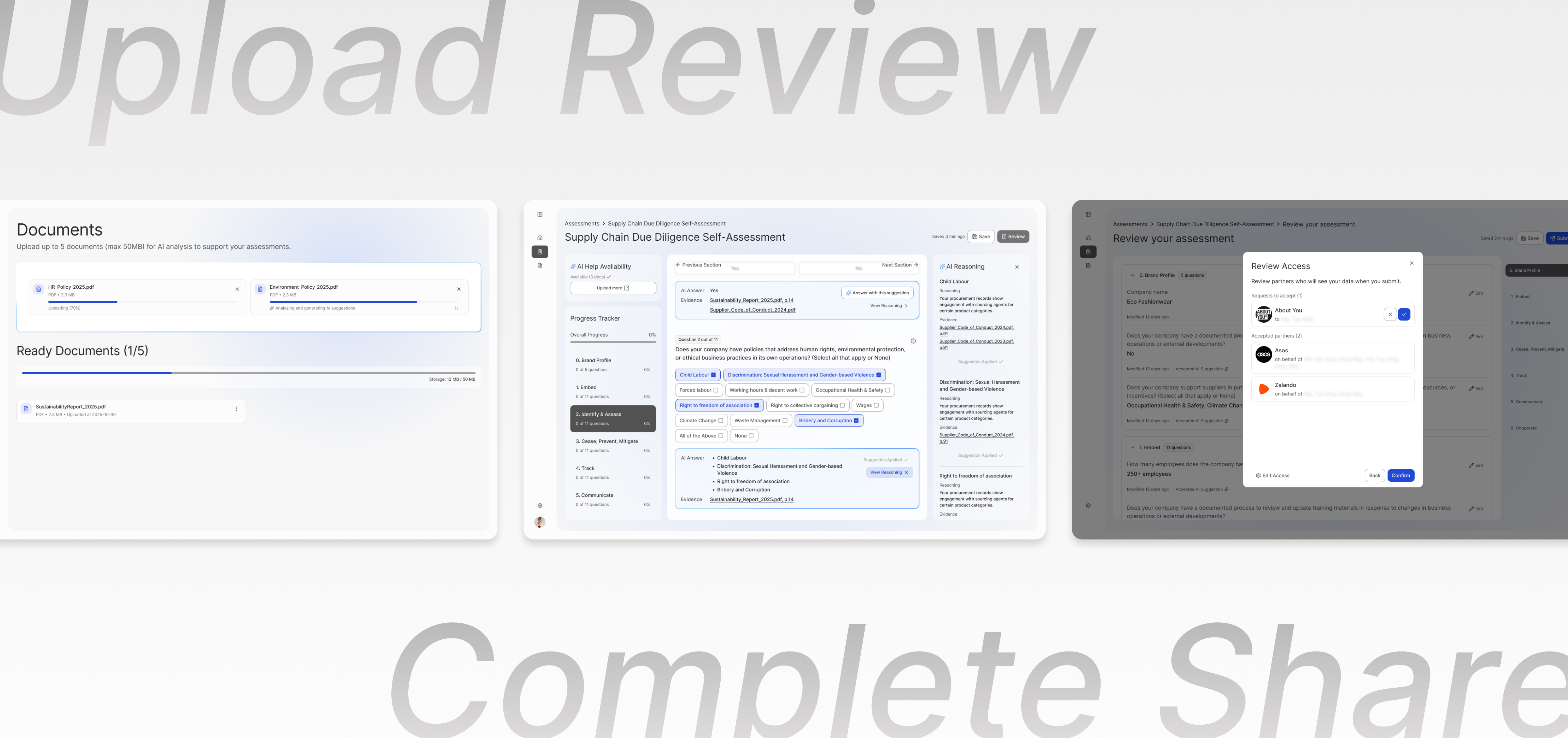
Each retailers' compliance assessments were eating 100+ hours of brands' time. One Retail Hub redesigned that experience around AI, where trust, not automation, drives every interaction.
Contribution
Product strategy ✺ Research ✺ Design system ✺ Prototyping ✺ Frontend implementation
Team
1 Product designer (me) ✺ 1 Product Director ✺ 1 Project Manager ✺ 1 UX Researcher ✺ 4 full-stack engineers
Timeline
Nov 2025 - Ongoing
The Problem
Fashion brands spend 100+ hours responding to each retailers' compliance assessments, answering the same questions repeatedly, in different formats, for every retailer that asks. There was no shared system, no memory, no way to work smarter.
What I did
Sole designer, 0 to shipped in 3 months.
I created an AI-augmented design-to-development framework with engineering, eliminating handoff in favor of shared ownership: a design constitution, AI prototyping, and direct code commits. Design fidelity reached ~95%. Alongside that, I built the design system foundation and scaled it to cover AI behaviors and interactions: the human-in-the-loop patterns that define how the product feels and build trust.
An AI prototype built during early validation closed a major European RFP before production even started.
AI-Assisted Design-to-Dev Framework
The OneHub project became a proving ground for a new way of working. Traditional design handoffs used to lose 30-40% of design intent between Figma and production. I wanted to see if AI could close that gap without taking creative control away from the designer.
As a result, I developed a five-phase framework where AI acts as a translator, not a creator, which allows designers to stay in control from pixel to production code. A shared constitution constrains AI to execute decisions, not make them. Figma MCP translates design tokens directly to code. The designer QCs every component and designs edge cases directly in code, resulting in no handoff, no interpretation gap.
The result: ~95% design fidelity in production (vs 60-70%), 4x faster delivery, and zero UX debt. After OneHub shipped, I documented the framework into a reusable guide and presented it org-wide, positioning design systems as critical infrastructure for AI-first product development at Trustrace.
Human-centered AI (HAI) Design Principle
AI in the passenger seat. One Retail Hub puts AI to work on the tedious parts, and keeps humans in charge of the parts that matter. Every interaction decision came back to the same question: when does surfacing AI actually help, and when should it step back?
That philosophy shaped not just the product interactions, but a new AI design system: intentionally understated, present when useful, invisible when not.
Outcome
Reduced brand compliance response time from 100+ hours to 36 minutes. Shipped in 3 months, presented at an OECD conference, and now live as TrusTrace's free-tier product.